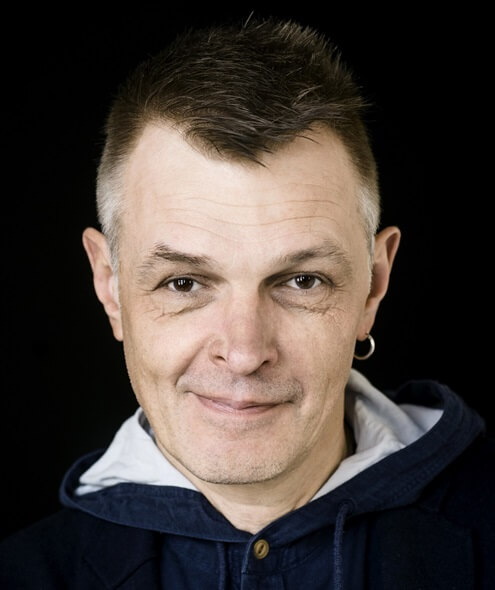
Gintaras Varnas
Theatre director and pedagogue Gintaras Varnas (b. 1961, Vilnius) is a representative of the first generation of directors trained in Lithuania, who created his earliest works on the eve of the country’s restoration of independence. Even before his studies, he gained experience in theatre, working as a stagehand and assistant director at the Lithuanian Russian Drama Theatre (now the Old Theatre of Vilnius, 1979–1982), as a director of an amateur theatre studio (1984–1986), and as assistant to director Jonas Vaitkus at the Kaunas State (now National Kaunas) Drama Theatre (1987–1988). He chose to study theatre directing at the Lithuanian Academy of Music and Theatre under course leaders Jonas Vaitkus and Rimas Tuminas (1988–1993), later completing his master’s degree and postgraduate art studies there (1997). During his studies, he founded the theatre Šėpa, which was led by him until 1992. The performances of Šėpa became a major political and cultural breakthrough of the time, offering a documentary analysis of the reality of Lithuania at that period. The director has remained committed to the challenges posed to political and social reality, as well as to the theatrical means employed in these works to this day—most notably, elements of puppet theatre.
Having worked as a freelance director since 1989, G. Varnas served as artistic director of the Kaunas State Drama Theatre from 2004 to 2007. Since 2005, he has been teaching at the Lithuanian Academy of Music and Theatre (professor since 2017), and in 2007, together with his first graduating class of actors, he founded the theatre Utopia. In 2012, G. Varnas began leading a directing course.
In major theatres in Lithuania, Latvia, and Slovakia, G. Varnas has directed around fifty drama and opera productions, with particular attention to dramaturgy from antiquity to the present day. Through his efforts, a number of classical works have been introduced into the Lithuanian language, and since 2015, on his initiative, the online archive of translated dramaturgy Drama Drawer (Dramų stalčius) has been developed.
Throughout G. Varnas work—on both drama and opera stages—one can observe poetic qualities, refined decorative aesthetics, and a particular sensitivity to music. His sense of directorial rhythm is especially evident in his opera productions: Richard Strauss’s Salome (1999), Giuseppe Verdi’s Don Carlo (2000) and Un Ballo in Maschera (2002) at the Latvian National Opera; Pyotr Tchaikovsky’s The Queen of Spades (2001), Giuseppe Verdi’s Rigoletto (2003), and Onutė Narbutaitė’s Cornet (2014) at the Lithuanian National Opera and Ballet Theatre; Charles Gounod’s Faust (2010) at the Slovak National Theatre; as well as widely acclaimed baroque repertoire interpretations initiated by independent companies—Claudio Monteverdi’s madrigal operas The Combat of Tancredi and Clorinda and The Dance of the Ungrateful (Banchetto musicale, 2008), and Antonio Vivaldi’s oratorio Juditha Triumphans (Baroque Opera Theatre, 2015).
After a longer break, the director has returned to opera this year and is collaborating with the Klaipėda State Musical Theatre for the first time, creating a directorial concept for a new production of Bronius Kutavičius’ opera The Bear (Lokys).
For his work across various genres, G. Varnas has received numerous major Lithuanian theatre awards: three Kristoforas awards (2000, 2001, 2002), five Fortūna awards (1998, 1999, 2005, 2006, 2018), four Golden Stage Cross awards (2003, 2004, 2008, 2014), as well as the Lithuanian National Prize for Culture and Arts (2005).