Dance Diptych
We invite you to an exceptional two‑part evening of dance, where contrasting choreographic visions and the language of contemporary dance meet on one stage.
This dance diptych consists of two choreographic works: Decrescendo by Swiss choreographer Marcel Leemann and Borrowed Landscapes presented by Klaipėda‑born choreographer Agnija Šeiko.
PART I
“Decrescendo”
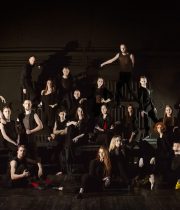
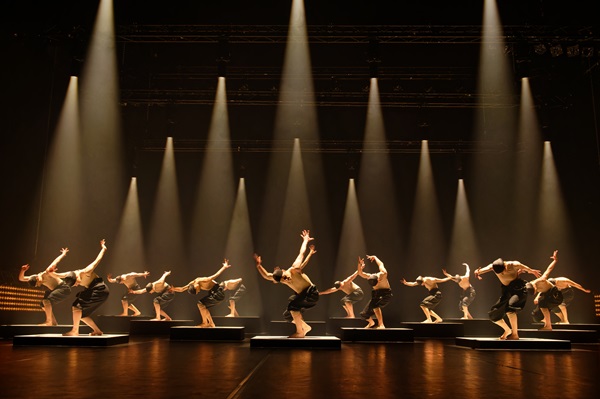
The dance performance „Decrescendo“ explores the phenomenon of group behavior through traditional and ritual dances as well as folkloric formations. The work reveals the tension between the collective and the individual, where personal expression disrupts established structures and creates moments of resistance. Here, group behavior is interpreted as a human and politically charged process, while tradition appears as a source of communication, safety, and belonging—something to which we repeatedly return.
Marcel Leemann
(b. 1969, Zurich) – choreographer, dancer, theatre director, and educator. He studied dance in Zurich, Stuttgart, and Budapest, gaining professional stage experience with the Dresden Semperoper, the Lucerne Theatre, and theatres in Bern.
Later, as a freelance artist, he founded the company Marcel Leemann Physical Dance Theater, touring throughout Switzerland and abroad. Leemann has created choreography and directed productions in dance, opera, musical theatre, and drama across various European stages. A significant part of his career has been dedicated to working with young people and advancing dance education, as well as leading the festival Physical Days Bern. Since September 2023, Marcel Leemann has served as Co‑Director of Dance at the Tyrolean State Theatre in Innsbruck.
Creative team
Marcel Leemann – Choreographer
Jonas Raudonius – Composer
Ayse Özel – Set and Costume Designer
Performers:
The KVMT Ballet Company.
The performance is presented with recorded music.
PART II
“Borrowed Landscapes”
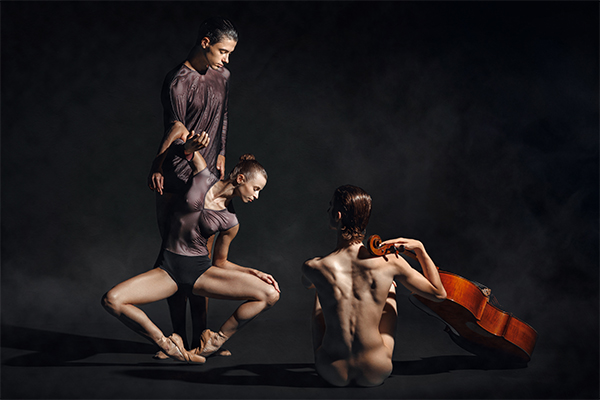
The dance performance Borrowed Landscapes is inspired by the Japanese garden concept of shakkei – the principle of “borrowed scenery,” in which a limited space intentionally incorporates what lies beyond it: mountains, sky, trees, architecture, other bodies, other stories. As in such a garden, the performance space is never closed; it is constantly extended by gaze, memory, and movement. There are no straight lines here: everything intertwines, slides, emerges, and dissolves again like patterns in sand, redrawn each time by a passing moment.
Time in this work is not measured chronologically – it acts as a weaver of coincidences and encounters. The dancers’ personal stories, their individual trajectories, and movement qualities merge into a shared “landscape tapestry,” where nothing stands as the central point, yet everything becomes an extension of something else. One’s personal “garden” ceases to be separate; it becomes part of a wider, intangible view, where the self is not an autonomous figure but someone’s edge, someone’s shadow, someone’s reflection.
The choreography intentionally avoids synchronicity and direct physical contact – connection is born through distance, through what remains unseen. Continuing the theme of invisibility explored in Onos, the work examines what stays when obstruction is removed: how a body moves when the forces pressing on it recede, and what “material” emerges in the emptiness. The dancers work with what has not been visible but has been shaping them – with traces, imprints, internal tension that becomes the source of movement.
The performance unfolds as a kinetic, ever‑shifting landscape. Its beauty arises not from permanence but from transformation. Nothing is created or controlled – it is allowed to happen. People and objects become part of the same landscape, their movements and “imprints” forming a kind of sand‑raking: temporary, fragile, yet constantly renewing itself. Thus, a borrowed, expanding landscape emerges on stage, where invisibility, extension, and disappearance blend into a living, breathing image.
Agnija Šeiko
(b. 1977, Klaipėda) – dancer, choreographer, dance educator, and contemporary dance creator; head of Šeiko Dance Theatre, guest lecturer at LMTA Klaipėda Faculty and Turku Arts Academy; recipient of the Golden Stage Cross; honorary citizen of Klaipėda culture.
She completed choreography studies (BA) and theatre studies (MA) at Klaipėda University, and in 2005 graduated from Codarts – Rotterdam Dance Academy. Šeiko has created more than 30 dance performances and projects in Lithuania and abroad, collaborating with artists across various fields and working on choreography for opera, drama, and musical theatre. Her creative work is known for interdisciplinarity, a distinctive aesthetic, and sensitive social themes.
Creative team
Agnija Šeiko – Choreographer
Sandra Straukaitė – Costume Designer
Edvardas Osinskis – Lighting Designer
Performers:
The KVMT Ballet Company.
The performance is presented with recorded music.
Main sponsor

Partly funded by