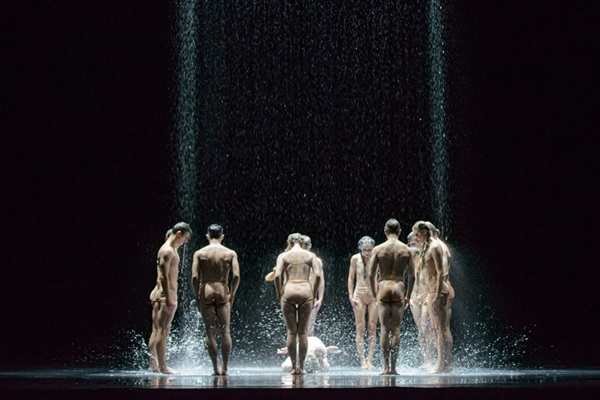
Frédéric Chopin: A Lifelong Love Story. December Rain
Guest Performance of the Estonian National Theatre Vanemuine at the Klaipėda State Music Theatre
“FRÉDÉRIC CHOPIN: A LIFETIME LOVE STORY. DECEMBER RAIN.”
A BALLET IN TWO ACTS
Composer: Frédéric Chopin
Director, choreographer, scriptwriter and set designer: Kristina Paulin (Slovakia/Germany)
Costume designer: Stephanie Bäuerle (Salzburg Landestheater)
Sound director and composer: Davidson Jaconello (Canada)
Lighting designer: Imbi Mälk
Assistant director: Silvia Azzoni (Hamburg Ballet)
Repetiteur: Jelena Karpova
Stage manager: Ülle Tinn
Director Kristina Paulin dedicates this ballet to her beloved father Ján Borbély.
Premiere: March 2, 2024, at the Vanemuine Theatre Small Hall
Pianist: Margus Riimaa
George Sand – Ana Maria Gergely
Frédéric Chopin – Alain Divoux
Solange, daughter of George Sand – Caroline Maquignon
Maurice, son of George Sand – Vladyslav Kalys
Chopin’s music – Bradley Howell
George Sand’s alter ego – Maria Engel
Ludwika, Chopin’s sister – Selma Strandberg
Two actors – Akihito Shimogata, Gerardo Avelar
Franz Liszt – Gustavo Pedro
Chopin’s mother – Natalie Barbis
Paris salon guests & Chopin’s music:
Elena Troisfontaines, Mallika Aithala, Ilona Voloshko, Maarja Praks, Mariko Ackermann, Yuta Irikura, Hodaka Maruyama, Benjamin Kyprianos, Noah Wheatley, Jack Fielding, Isaac Calstar Fisher, Spike Frobisher
In the ballet “December Rain” my central focus is the significant events in Frédéric Chopin’s life, his relationships, and his love for the French writer George Sand. The entire composition is inspired by the events of Chopin’s life. My goal was not to follow his biography literally, but to explore the emotional dimension of his most important moments, themes, and experiences.
For several years, I have been studying Chopin’s biography. I was moved and inspired not only by his beautiful music but also by the complexity of his life. One can truly understand who he was only by listening to his compositions, for it was through them that Chopin expressed himself. In this ballet, I wanted to portray what I believe he felt, what his thoughts were, and what was happening in his mind at each stage of his life.
Franz Liszt wrote of Chopin: “He used his art only to play his own tragedy to himself.” This became my principal source of inspiration—his inner world and the duality of his conflict with the outer world. There is no need to describe Chopin with words. I simply listen to his music and feel his soul. Chopin is his music; he placed his soul into his art, preserving the struggles of his life and his devotion to creativity. Through his art he will remain with us forever, and with this ballet I want to share my interpretation of his greatest works and offer insights into his story and life.
— Kristina Paulin, Director
Synopsis
The ballet tells the tragic love story of Frédéric Chopin and the writer George Sand. The narrative opens at the composer’s deathbed, where Sand is absent, and memories return to their first meeting in Paris, the blossoming of their love, and the early signs of Chopin’s illness.
A winter journey to Mallorca is meant to support Chopin’s health and inspire creativity, but constant rain, family tensions, and his worsening condition create strain. As his health declines, the family eventually returns to Paris.
In the second act, the relationship between Sand and Chopin slowly deteriorates—she grows exhausted from caring for him, while her son Maurice becomes increasingly hostile. Meanwhile, Solange grows more attached to Chopin. The conflict between Sand and her daughter, Solange’s marriage, and the end of correspondence between Sand and Chopin ultimately separate the lovers for good.
Near the end of his life, Chopin is visited by his sister Ludwika. He recalls his family and performs his final concert. The ballet concludes with his death, mirroring the opening scene.
Vanemuine National Theatre
Located in the city of Tartu, Vanemuine Theatre is the oldest theatre in Estonia performing shows in the Estonian language, founded in 1870. It is also the country’s first professional theatre (established in 1906) and the only theatre that stages productions across three genres: opera, operetta and musical theatre, as well as classical and contemporary ballet and drama.
The theatre operates in three different buildings and employs over 350 people, including an international ballet company and a large symphony orchestra. Guest soloists frequently perform here. Vanemuine is a repertory theatre, presenting more than 50 productions of various genres each season.
Synopsis
The action takes place between 1838–1849 in Paris and Nohant (France) and in Mallorca (Spain).
Act I
The story begins at the end of Frédéric Chopin’s life. To his disappointment, George Sand is not with him during his final hours, although she had promised to be. At the moment of his death, his sister Ludwika and George Sand’s daughter Solange are by his side. After Chopin’s death, Ludwika fulfills his wish and brings his heart back to Poland.
George Sand is in her room writing a book. Her daughter Solange returns from Chopin’s funeral and plays his music on the gramophone. Sand, who shared a tragic love story with Chopin, finds this inappropriate and starts an argument. Upset, Solange leaves, and Sand remains alone. Memories of Chopin return, and his shadow appears in the window. She is interrupted by her jealous son Maurice, who turns off the music and takes away the gramophone. After he leaves, Sand finds her diary, and her thoughts take her back to the moment she first heard Chopin play in Paris.
Guests arrive for Chopin’s concert. Among them is the young revolutionary Sand—hearing Chopin’s music for the first time. Captivated at once, she faces Chopin’s displeasure: a woman in a suit, smoking a cigar. Unfazed, Sand continues to seek his attention by sending him her novellas. Eventually Chopin becomes fascinated by her as well, and they fall deeply in love. At the same time, the first signs of Chopin’s illness appear.
Chopin, Sand, and her children decide to spend the winter in Mallorca so that Maurice might recover from rheumatism, Chopin could compose, and Sand could work on her books. At first they seem to enjoy their time as a family. But Maurice dislikes his mother’s new lover. Feeling deprived of her full attention, he grows jealous. Knowing she will search for him, Maurice runs into the storm.
They hope the warm climate will improve Chopin’s health, but that year Mallorca experiences heavy rain, and Chopin grows weaker. His piano has not yet arrived, depressing him greatly. Tensions rise, arguments erupt, and Chopin becomes overwhelmed, longing to return home and focus on music.
Chopin falls seriously ill. Doctors visit him and offer no hope. Locals fear his illness may be contagious, and the family is forced to leave their lodging. They move to the abandoned Carthusian monastery in Valldemossa. Life there is frightening and filled with ghostly visions for Chopin. Sand often goes on long walks, leaving Chopin lonely. At last, his piano arrives and he composes several beautiful works, including the 24 Preludes, Op. 28.
Doctors examine Chopin again. Meanwhile Maurice shows his paintings to his mother, but Sand is distracted by Chopin’s cries. Maurice is upset—Chopin receives all the attention. Conflicts grow, and Chopin’s declining health forces the family to return to Paris.
Intermission
Act II
George Sand is alone in her room in Nohant, smoking a cigar and working on a new book. Her children and Chopin have returned to Paris, where Chopin tries to continue composing. Eventually he returns to Nohant and finds peace again. He plays a melody that reminds him of home and of his sister Ludwika. At night he writes his famous nocturnes.
Maurice can no longer bear Chopin’s music—it drives him mad. Solange, however, becomes enchanted with Chopin and falls in love with him. While obliged to care for Chopin as if he were “disabled,” Sand begins to feel as if she has three children.
At a concert in Paris, Chopin is accompanied by Franz Liszt, who performs the “Revolutionary Étude” (Étude No. 12 in C minor, Op. 10). As Liszt performs, Chopin’s thoughts drift to memories of his family in Poland. The piece was composed during the failed 1831 November Uprising against Russia; it expresses Chopin’s deep sorrow over these events.
Caring for Chopin becomes overwhelming for Sand. Their love has changed. Maurice decides to leave, but Chopin stops him and chooses to leave himself instead.
Chopin’s physical and mental state deteriorates due to tuberculosis. Alone—without Sand, without his family—his world collapses. Only his music remains. His mind becomes a chaos of notes and haunting visions.
Solange grows into a beautiful young woman. She starts visiting Chopin in Paris, bringing hope and light into his life. They grow very close. Soon Solange marries sculptor Auguste Clésinger, causing a bitter conflict between her and Sand. As Solange matures, the disagreements intensify. Solange disapproves of her mother’s unconventional lifestyle, while Sand opposes her daughter’s closeness with Chopin. Solange’s marriage ultimately leads mother and daughter to sever ties. Solange continues visiting Chopin and convinces him to support her in this estrangement, ending all correspondence between Sand and Chopin.
Chopin’s health worsens. He writes to his sister Ludwika, asking her to come to Paris because he is dying. He remembers his childhood and his mother. His sister cares for him. Chopin performs his final concert. His life passes before his eyes. Sand and Chopin meet one last time—by chance.
The ballet ends exactly as it began: with Chopin’s death.